Dam nutrition, the microbiome and colostrum
The importance of maternal health and nutrition
How important is a mare’s health and nutrition before and during pregnancy?
The short answer is: extremely important.
Emerging research highlights just how strongly the uterine and overall maternal environment influence a foal’s growth, metabolism and risk of orthopaedic issues. Yet in practice, breeding mares (including surrogate mares) are often older and not always maintained on optimal diets.
We know that the conditions a foal is exposed to during early development - particularly around conception, gestation and the neonatal period - can have a far-reaching impact on a foal’s long-term health. The foetus adapts to its environment to survive, and these adaptations may increase the risk of metabolic disease later in life. For this reason, minimising stress and ensuring proper nutrition are critical throughout pregnancy.
Epigenetics and foetal programming
Nutrition, inflammation and metabolic status can all influence epigenetic markers, changes that may permanently alter patterns of gene expression. (We’ll explore genetics in more detail in next month’s article.)
While in the womb, the foetus also relies on maternal “cues” to anticipate the environment it will be born into.
For instance, if nutrient availability appears limited during gestation, the foetus may adapt by becoming more metabolically efficient. If the postnatal environment matches that expectation, this adaptation can be beneficial. However, if a nutrient-restricted foetus is instead born into a nutrient-rich environment, that same adaptation may increase the risk of obesity or insulin resistance later in life.
Ultimately, it is this inconsistency in nutrient supply before, during and after pregnancy that contributes to long-term health challenges in the foal.
These built-in survival mechanisms are a natural and essential part of life and cannot simply be “switched off.”
Because of their importance, careful attention must be given to the health and nutritional status of breeding mares. When environmental conditions shift or metabolic stress is prolonged, these otherwise beneficial adaptations can become maladaptive.
In horses, this may present as issues such as insulin dysregulation, chronic low-grade inflammation, altered cardiovascular function, or orthopaedic conditions like osteochondrosis.
The role of embryo transfer and recipient mares
Embryo transfer is becoming increasingly common in breeding programmes. In these cases, the recipient mare plays a significant role in influencing the growth and development of the embryo.
Research shows that maternal size and the uterine environment can either enhance or limit foetal growth beyond what genetics alone would predict, while also affecting metabolism and the risk of osteochondrosis before 18 months of age.
This makes the selection of a recipient mare critically important. Ideally, she should closely match the donor mare in size and breed and be maintained on a high-quality nutritional diet to support optimal development.
Balancing undernutrition and overnutrition
It is essential to strike the right nutritional balance, as both undernutrition and overnutrition can influence foetal development. While moderate undernutrition of around 80% of energy requirements may not affect birth weight, it can trigger placental adaptations such as increased vascularisation and enhanced nutrient transport.
On the other hand, overnutrition and obesity are linked to insulin resistance and increased low level inflammation in the offspring which can lead to problems later in life.
The gut microbiome and colostrum quality
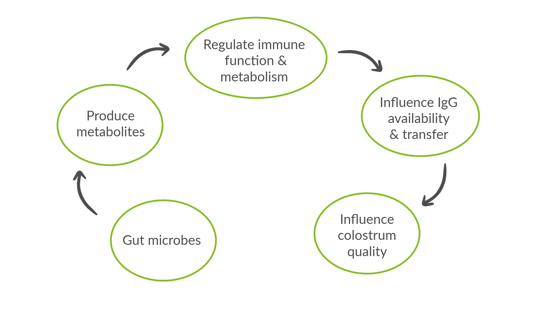
There is also a growing body of research highlighting a link between a mare’s gut microbiome and colostrum quality. The hindgut microbiome does far more than simply digest fibre, it ferments it to produce important compounds such as short-chain fatty acids (SCFAs), including acetate, propionate and butyrate, as well as secondary metabolites derived from amino acids and bile acids. These substances don’t remain in the gut; they enter the bloodstream and are transported throughout the body to support metabolic function.
As discussed in previous articles, the gut microbiome plays a key role in regulating the immune system. SCFAs, particularly butyrate, are especially important as they support B-cell development and antibody production. This can increase the availability of immunoglobulins (IgG) for transfer into colostrum.
These metabolites may also act more directly. SCFAs interact with receptors - such as G protein-coupled receptors - on mammary tissue. This interaction may help maintain the integrity of tight junctions in mammary epithelial cells, influencing how efficiently immunoglobulins are transferred into colostrum. Emerging evidence, largely from other species, also suggests that microbial metabolites can affect gene expression within the mammary gland, including proteins involved in immune transfer.
Breeding and pregnancy can be physically and mentally demanding for mares, and stress is known to negatively impact the gut microbiome, potentially leading to hindgut dysbiosis. This imbalance may reduce colostrum quality by lowering IgG content. Colostrum production itself is also metabolically demanding, further emphasising the importance of optimal gut health and a complete nutritional diet.
Hindgut dysbiosis and its impact
So, what does hindgut dysbiosis mean for colostrum quality? When dysbiosis occurs, the production of beneficial species that produce SCFAs declines, while pathogenic bacteria often increase.
The hindgut environment can become more acidic due to elevated lactic acid production, which may damage the gut lining and reduce its integrity, often referred to as ‘leaky gut’.
This allows endotoxins to enter circulation and contribute to systemic inflammation. As a result, immune function may be impaired, circulating IgG levels reduced, metabolic signalling altered and nutrient utilisation compromised, all of which can negatively affect the transfer of IgG into colostrum.
What does this look like?
A simple way to visualise this relationship is:
Practical management tips for breeding mares
So, how can we support our breeding mares?
- A strong foundation begins with a well-balanced, nutrient-rich diet and management practices that support optimal gut health:
- Maintain a consistent, high-quality forage-based diet
- Avoid sudden dietary changes, especially late in gestation
- Prevent starch overload
- Support the hindgut microbiome with evidence-based probiotic strains
- Minimise unnecessary antibiotic use
- Ensure adequate intake of trace minerals and vitamins, particularly in late gestation
- Reduce stress in the final weeks before foaling
- Give adequate consideration to your choice of recipient mare if using embryo transfer.
For more information about the role of the microbiome in equine breeding programmes, please get in touch.