
The gut-brain axis: a new frontier in performance and behaviour
In today’s equine industry, there is a growing focus on developing athletic potential through informed and considered management.
Breeding programs are more targeted than ever, with the right mares matched to certain stallions, while nutrition, training and recovery are carefully calibrated with increasing precision.
However, horses’ mental wellbeing is now receiving more attention (rightly so!), and our understanding of what truly shapes equine performance is beginning to shift alongside.
Each horse is unique. But where does individuality end and pathology begin? Phrases like “he’s always been this way” or “she’s just mare-ish” are common ways of explaining away personality traits, especially those that are undesirable.
However, as we better understand the links between gut health and behaviour, we must ask ourselves: can we influence how heightened stress responses impact the body, and in turn improve horse health and wellbeing?
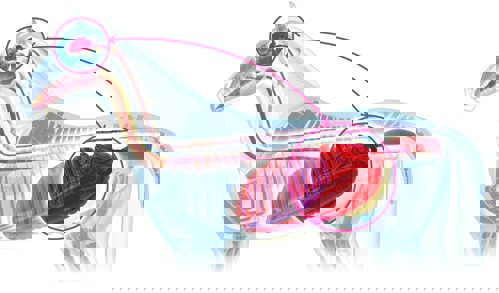
Emerging evidence indicates that an equine’s mental state is intricately connected to their gut health via the gut-brain axis, a two-way communication system that links the gastrointestinal tract with the central nervous system (CNS). In this context, the saying “a gut feeling” takes on a literal meaning.
A microscopic powerhouse: the equine hindgut
The equine hindgut microbiome is a vast and dynamic community of trillions of microbes that is inextricably linked to health and welfare. These organisms ferment fibre to produce metabolites linked to a range of bodily functions and systems. Critically, some of these are directly linked to the brain and specific neuron receptors interact directly with receptors in the brain, allowing the hindgut microbiome to influence mood, behaviour and even learning capacity.
This microbial influence on brain function has led researchers to coin the term “psychobiotics” to describe those microorganisms that positively impact behaviour and mental health. This is not just theoretical; there’s growing evidence, including in equine studies, suggesting that gut microbial balance can alter behavioural patterns. A better understanding of these microbes may even contribute to a change in how we train and manage horses and ponies.
Anatomy of communication: gut and brain in dialogue
The communication between the gut and the brain is governed by several physiological systems.
The vagus nerve – one of the body’s longest cranial nerves – acts as a direct line between the gut and the brainstem, with both sensory and motor fibres. It controls involuntary bodily functions such as breathing, digestion and heart rate.
Alongside this, the enteric nervous system (ENS), often called the “second brain” or “brain of the gut”, operates with around 100 million neurons and can function independently of the CNS and controls digestion.
Together, these systems form a complex neurochemical network that relies on hormonal, immune and microbial signals to maintain homeostasis. This balance is essential for optimal physical and mental health in horses.
When balance is lost: dysbiosis and its consequences
When the microbiome is thrown out of balance, otherwise known as dysbiosis, the consequences can be significant, whether caused by physical stress (e.g. exercise, injury) or psychological stress (e.g. social isolation, competition, lack of foraging, travel), long-term or short-term.
When this occurs, beneficial fibre-digesting microbes decline, while lactic acid-producing and pathogenic species proliferate. This change disrupts fibre fermentation, impairs nutrient absorption and alters the metabolites produced in the hindgut – including those directly linked to behaviour, mood and learning capacity.
This has a knock-on effect to gut integrity, damaging the delicate epithelial lining of the digestive tract. This compromised gut barrier, or “leaky gut”, enables a release of endotoxins and pathogens into the bloodstream, which can further impair physical and metabolic performance of the horse.
Over time, a leaky gut can lead to systemic inflammation, a weakening of the blood-brain barrier and interference with memory, cognition and mood. In such cases, what may present as anxiety, poor focus, or resistance under saddle could, in fact, originate from microbial imbalance and gut inflammation.
The neurochemical link
Gut microbes also produce neurotransmitters such as serotonin and dopamine, both crucial for mood regulation. They can also convert the amino acid glutamine into gamma-aminobutyric acid (GABA), a mood regulating neurotransmitter. GABA produced in the gut may influence brain chemistry through specific transporters within the blood-brain barrier.
Moreover, short chain fatty acids (SCFAs) have been linked to the regulation of appetite in humans, showing that SCFAs can reduce ghrelin receptor signalling. Horses that exhibit stereotypic behaviours like crib-biting have been found to have elevated ghrelin levels, suggesting a tangible link between microbial metabolites and behavioural outcomes.
The stress response loop
The stress response in the brain also has a significant role to play in the gut-brain axis.
The sympathetic nervous system (responsible for fight or flight response) and the parasympathetic nervous system (promotes relaxation) comprise the autonomic nervous system (ANS) and aim to remain in balance with one another.
However, stress activates the sympathetic nervous system – along with the hypothalamic pituitary adrenal (HPA) axis that produces cortisol.
In the short term, this helps horses respond to challenges. However, chronic stress disrupts microbial composition, weakens gut barrier function, suppresses immune activity and can induce norepinephrine release. Elevated cortisol can increase gut permeability, while norepinephrine promotes the growth of pathogenic species such as Salmonella, Listeria and Campylobacter – when combined, making it easier for pathogens to enter the bloodstream.
Long-term, this creates a feedback loop of dysbiosis, inflammation and behavioural challenges. Horses may become more anxious with diminished ability to store memories, dramatically interfering with training. They may also become more reactive, struggle with training or develop stereotypies like crib-biting, head nodding and weaving. Managing stress and supporting gut health must therefore be seen as inseparable components of equine care.
Implications for practice
This evolving understanding of the gut-brain axis highlights the need for a paradigm shift in equine management. While genetics and training remain critical, supporting optimum gut microbial stability could become a vital strategy in promoting calm, focused, and resilient equine athletes.
Through targeted interventions we can harness the power of the microbiome to support not just digestion, but the very mind of the horse.
Contact us to find out more about this emerging area of research.